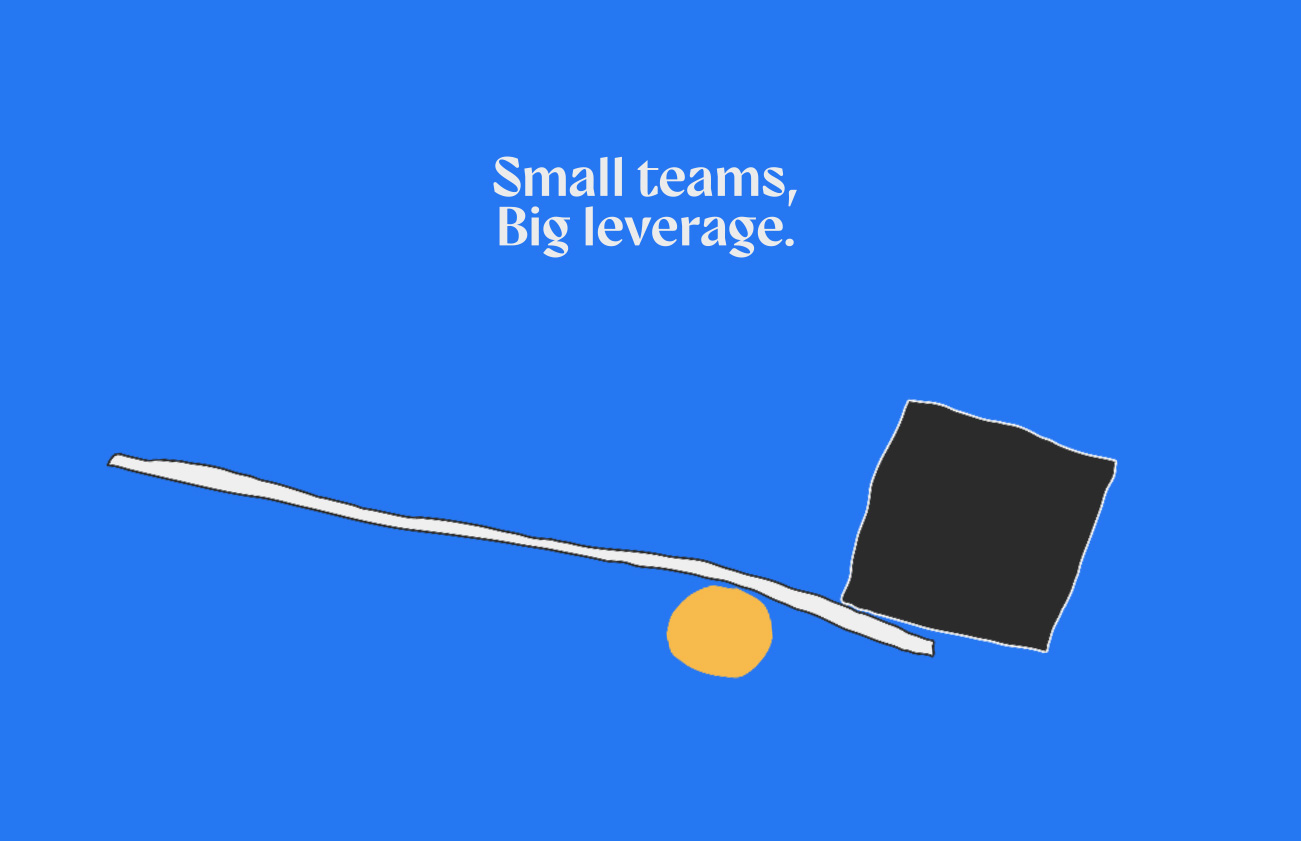

“Scalable” has become one of the most overused—and misunderstood—words in brand building.
Every case study promises it. Every agency claims it. Every founder is told they need it. But ask ten people what brand scalability actually means, and you’ll get ten different answers. Most of them might be anchored to size, funding, or hypothetical growth curves that may never materialize.
The myth goes something like this: scalability is for venture-backed startups, global enterprises, and teams with marketing departments larger than the average company. Scalability in this realm is about preparing for explosive growth, international markets, and hundreds of people touching the brand every day.
But that framing misses and almost limits the point.
Most brands don’t need to scale to $100M ARR. They need to scale their clarity. They need to scale their consistency. They need to scale their ability to create without constantly reinventing the wheel, burning themselves out, or wasting dozens of hours on meticulous and repetitive tasks.
This article is for founders, marketing leaders, and small teams who are trying to do more—without breaking their brand, their systems, or their sanity.
Let’s talk about what brand scalability actually means.
What Is Brand Scalability, Really?

The Loudest 1%: Scaling Brands for Large Teams and Global Footprints
When people talk about brand scalability, they’re usually talking about the loudest one percent of organizations: enterprise brands with global reach, distributed teams, multiple markets, and dozens—if not hundreds—of people producing content at once.
In that context, scalability means governance. It means guardrails, templates, permissions, approvals, and systems that prevent chaos. It’s about enabling speed to market without dilution, ensuring that a campaign launched in one region doesn’t feel disconnected from another, or that a new product doesn’t undermine the core brand story.
And to be fair, these brands do need documentation, design systems, brand hubs, and clearly defined rules for how the brand flexes and where it doesn’t. And they need those systems because the cost of inconsistency at scale is enormous.
But this is where the conversation usually stops and why it becomes unhelpful for most businesses. After all, at the top 1%, there’s only 1%.
The Real 99% Case: Scaling Brands for Small Teams and Limited Resources
For the other ninety-nine percent of brands, scalability looks very different.
It doesn’t mean preparing for dozens of people to touch the brand. It means making sure the same few people (or person) aren’t constantly stuck figuring it out from scratch. It means being able to write a newsletter, launch a campaign, update a website, or post on social media without pausing to ask, “Wait… how do we say this again?”, “What are our colors?”, “What font should I use?”
In this case, scalability isn’t about growth for growth’s sake. It’s about production.
A scalable brand gives small teams an unfair advantage, turns consistency into momentum, and allows you to increase output without increasing confusion, meetings, or rework. When scalable brand systems exists, decisions get faster, and your brand growth multiplies.
That’s what scalability actually is: the ability to grow output and impact without growing headaches.
What Makes a Brand Scalable?
Clear Brand Foundations (Before Anything Else)
Scalability starts with a commonality of foundations.
Purpose, positioning, values, and promise aren’t abstract exercises—they’re decision-making tools. They answer the questions teams face every day: What do we say yes to? What do we leave out? What actually sounds like us? What position do we take?
When those foundations are unclear, everything else grinds to a halt. Teams debate tone of writing and brand content and messaging splinters from one team member to another. But when foundations are solid, they act like a compass. You don’t need approval for every choice because the direction is obvious.
At Overmatter, we call this a Brand Core.
Repeatable Messaging Systems
A scalable brand doesn’t rely on clever copy or one-off lines. It relies on repeatable structure.
The best brands get built on a set of messages, or common language, because everyone on the team can understand simple, refined messaging, and repeat it. Brand messaging systems give teams shared language and eliminate guesswork. They allow marketing, sales, leadership, and product to tell the same story without memorizing scripts.
When messaging is systemic instead of improvisational, output increases naturally. People stop reinventing the message and start reinforcing it.
Flexible Visual Systems (Not Rigid Brand Books)
Scalable brands aren’t so much rigid as they are elastic.
They bend, stretch, and move organically around culture or what the business needs to say at the moment, but always returns to a familiar resting place. A visual system that can’t adapt will eventually break, and a brand that only works in one format, one layout, or one campaign isn’t scalable—it’s fragile.
Designing for flexibility means accepting that not everything will look identical—but everything should feel like it was produced by the same company or person. When a system is well-designed, it can absorb new ideas without losing its center of gravity.
What’s at Stake for an Unscalable Brand
Every Asset Becomes Reinvention
In unscalable brands, every new asset feels like starting over. Not only do you or your team have to create a new file from scratch, but you’re also hunting around for all of your brand assets, what things are supposed to look like, and left wondering how it all fits into a larger narrative.
Teams spend more time deciding how to say something than actually saying it. Each campaign requires debate, or worse: committee decision. The cognitive load adds up quickly.
Inconsistent Messaging Creates Internal and External Friction
Sales might tell one story while marketing tells another—all the while leadership speaks in abstractions and goals too ambitious to reconcile. Now, it may be that no one is wrong—but no one is aligned either. Internally, the brand feels unreliable and more like a war of egos, which eventually shows up externally.
Brand confusion acts like an operational tax. It slows decisions, erodes trust, and quietly drains energy from the organization.
Long Hours Masquerade as Growth Scaling
Many brands confuse motion with momentum. Regardless of the number of hours any team member puts in, only about 4 hours per day can be spent in deep work. So if 2 of those hours are spent on recreating brand collateral each day, that’s half of a worker’s effectiveness gone.
Scalable brands give teams the tools, assets, and language they need to create materials quickly, and then move on to building other assets for the business.
Brand Scalability: Subtraction, Not Addition
Just like a closet in a well-lived house, or an extra bay in a garage, most brands accumulate instead of subtract. Old taglines linger, campaign language never gets retired, and messaging layers stack on top of each other until the core is buried. What started as clarity becomes clutter.
This is messaging debt—and like any debt, it compounds until you’re tripping over old Christmas decorations to get to your garden hose.
Scaling for Sanity and Revenue
How Brand Scalability Impacts Revenue
Scalability, for those with financial divining rods, also positively impacts revenue.
It’s no secret that well-defined systems lead to faster execution. Faster execution leads to more output. And when output is consistent, it compounds into brand equity. That equity shows up in trust, recognition, conversion, and pricing power.
As previously stated, even the hours gained back from repeatable systems for employees makes brand scalability worth the investment. Getting 25–75% more efficiency out of a marketing employee can mean thousands of dollars added to the bottom line before any outside factor alone.
All of this compounds into a multiplying effect.
When Scalability Means Peace of Mind
There’s a human side to scalability, too, that rarely gets talked about: revenue matters, but so does sanity. One of the most undervalued benefits of brand scalability is what it does for decision-making speed and team morale.
Faster decisions mean you're not stuck in endless debate cycles about whether this headline or that image is "on brand." You have frameworks that provide answers. You can trust the system and move on to the next thing.
Scalable brands reduce stress. They remove second-guessing, create confidence in decision-making, and enable leaders to stop firefighting and start building. With a scalable system in place, leadership is able to trust in brand output more, and turn their attention to leading and growing the business, not worrying about what the next social post might look like.
Small Teams, Strong Systems
It might not seem intuitive, but small teams benefit the most from scalability.
When systems are clear and simple to follow, marketing efforts accelerate instead of stalling. Today, so much of an online presence is the sheer volume of output, so slick systems help build the foundation of marketing volume. The brand and systems should work with the team instead of against them.
Consistency doesn’t kill creativity—it enables it.
Consistency Kills. I’ve said this since I was an athlete, and it’s true about brand presence in a world where content duration is minuscule, and audiences need only the slightest hint of wavering to abandon ship.
When you build strong systems that guide without constraining, when you establish clarity that accelerates instead of slowing down—consistency becomes a creative multiplier. You produce more because you're not starting from zero. You create better work because you're building on a coherent foundation instead of fighting against fragmentation.
{{bravemark-01="/components"}}
How to Start Building a Scalable Brand (Without a Rebrand)
Audit What Exists in Your Brand
Start by looking at what’s actually being used—not what’s documented:
Where do teams get stuck? Which assets get reused? Where does confusion show up most often? The answers tell you where scalability is breaking down.
These are oftentimes the simplest fixes, and greatest compounding investments. A simple exercise is to outline a two-week period where anytime a familiar asset is created or recreated, to also develop a template on the spot. Yes, you’ll have two grinding-slow weeks, but the following weeks and months will explode with multiplied results.
Clarify Before You Create
I’ve never met someone who could design their way out of confusion. And I’ve met a lot of incredible designers.
The biggest mistake teams make is jumping straight to execution. They want new brand guidelines, new templates, new assets. But if you build on top of unclear foundations, you're just creating a more sophisticated version of the same mess.
Without a clear process, clear message, or clear tone of presence, everything a brand creates has some amount of trepidation. To build a scalable brand starts with clarifying the parameters of the brand so it’s easier to amplify and expand.
Build Tools That Generate Outputs
While I love a good set of brand guidelines, scalability lives in tools, not guidelines.
Templates, frameworks, shared language, and repeatable processes make on-brand work the easiest option. When clarity is accessible and the easiest path forward, employee adoption follows naturally.
Brand scalability isn’t about preparing for some imaginary future. It’s about making the work you’re doing right now easier, clearer, and more effective.
A scalable brand grows without losing itself. It compounds instead of fragments. It creates momentum instead of exhaustion.
And for most teams, that’s the real win.